Monday, June 30, 2014

Tiny Horsies

 My first two attempts at polymer clay sculptures, painted with acrylic inks. Horses, of course. The acrylics were really too thin, and hard to work with. So the inks may not be the best choice, but at this point almost everything in the house that hasn't actively run away has been painted with them. Maybe powdered pastels and fixative will work better next time.
Little polymer clay horses.
Grey draft horse. 
Arabian horse, apparently with casts on all four legs. Poor horsie.
The mane came out looking really cool though. 
The legs were the most awkward part, not sure what to do about that. I put little wire skeletons inside the clay, and the clay had a hard time sticking to it. So maybe I can skip the wire, or bake a few parts at a time.
Also learned the important lesson of doing the most delicate part last. Had a perfect set of ears on the draft horse, then got to messing with another part and realized I had smushed them.

Sunday, June 22, 2014

Tiny Elephant

Playing with oil based clay lately, it's fun to mess with and doesn't ever harden.


Sunday, May 18, 2014

Quickies

All of these paintings were done in less than three hours, and mostly in one sitting. I had to come back after the first layer dried and add in the bright whites in the clouds. 
Weaver's Needle, 5x7 inches, oil on canvas panel, finished.
Weaver's Needle, detail of clouds.
Port A Dunes,  5x7 inches, oil on canvas panel, finished.
Port A Dunes, detail.
Wupatki Grasses, 5x7 inches, oil on canvas panel, finished.

Sunday, May 4, 2014

Long Landscapes

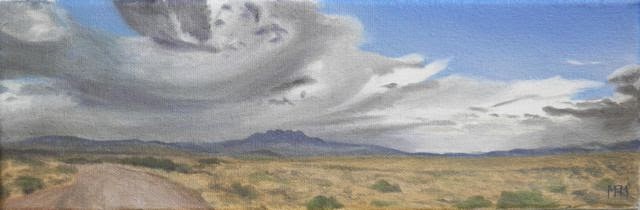
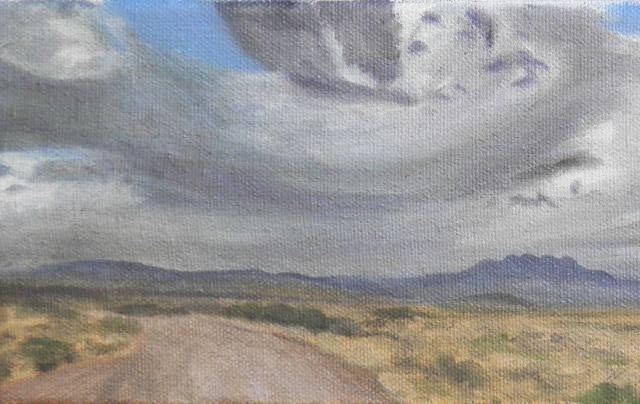
Two 4x12 inch landscape paintings on canvas. First one is of Four Peaks in Arizona, and the second is a view from Big Bend, in west Texas. 
Four Peaks, 4x12 in, oil on canvas, probably finished.
Four Peaks, detail. 
I changed the color of the blue in the sky on Four Peaks, the first color just didn't match. So the clouds aren't quite blended to the sky in a few places, but I don't think I'll spend any more time on this one.

Big Bend, 4x12 in, oil on canvas, finished. 
The sky is one of my favorites, it came out a subtle blue and blends into the haze of a hot afternoon. 

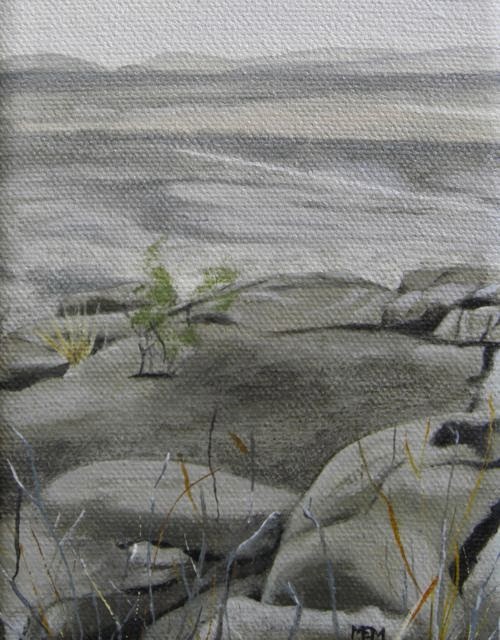
Big Bend, foreground detail.  
The paint on the rocks at the bottom is shiny from the Galkyd medium, to help it stand out from the far away background. The sky and the mid-ground was painted with no medium, so it's matte. I also found  a new trick for making really thin lines. The grasses were very tedious to do with a paintbrush, so I dipped a thread in paint, pulled it tight and stamped it down. Paint stayed exactly in a thin line, and some of it kept some raised texture. I think curved shapes could be made by carefully dropping the string from one end, too. 

Tuesday, October 29, 2013

Little White Flower

 I found this little flower at a family reunion during March in central Texas, a few years ago. For the longest time I couldn't easily identify it, because it wasn't in the few books I have for Texas wildflowers. But after giving up on books and after poking around on the internet for a bit I realized that was because I was looking for a white flower, and Anemones are usually purple. This is a windflower, an Anemone berlandieri, and they can be white, blue, purple, pink, or greenish. And those parts that look like petals are actually sepals. And its poisonous. Tricky little flowers. Almost as tricky as this painting turned out to be.

This is an oil painting on a 5x7 inch Claybord. I came across two issues with this painting:
 1. Dull, sunken areas in the background
2. Places where the paint flat out wouldn't stick to the board. It never really dried, and just wiped right off. 
Anemone, unfinished, first layer.
Normally the first layer painted on a Claybord is a mess, you can't blend it because the board just sucks it right up as soon as it touches the board. I put up with that because you can scrape back to bright white without scraping through the gesso and ruining the painting, and that's pretty useful for some pictures.
Even after the first few layers of this one though the paint was dull and dry looking=Problem #1. But this wasn't too hard to deal with, it just needed an "oiling out". That means brushing on a good covering of Linseed oil (or whatever medium you're using), let it sit a minute or two, and then wipe off with a lint-free cloth. All the paint has to be totally dry before this, or else it will smear and make a mess. But after an oiling out the paint will be evenly shiny all over and your layers will adhere to each other better. And if an area of paint has enough oil, the stuff you brush on will just bead up on top, not soak in, and wipe right off. You can paint right after that if you want, or let it dry a few days.
Anemone, unfinished, second layer on background, flower untouched. 
The second problem was one that I hadn't run into before. I covered the flower petals in Titanium white and left it to dry a few days (or weeks, who knows, I wander off sometimes...) When I went to check if the paint was dry, it came off on my finger tip like powder.
Anemone, shiny white areas are where paint peeled off the panel.
You can see the shiny areas where the paint rubbed right off and the panel shows through. It seems like the panel pulled all of the oil right out of the paint and the pigment was left sitting on top with no binder to hold it together. The Titanium White I use has walnut oil as the binder, because it yellows less than linseed oil. Maybe that combo reacted badly with the board, who knows. The solution to Problem #2 was the same as the solution to Problem #1= Oiling out. I saturated the flower area with linseed oil twice, then tried another layer of paint. (Probably should have used an oil that will yellow less, but I didn't feel like going to buy anything) That layer stuck, dried out, and seemed to work fine.
Anemone, finished, oil painting on a 5x7 Claybord. 
Anemone, finished,  with the paint from the last session on the palette.
Definitely an annoying learning experience, but a nice painting at the end. I probably won't sell it for a few years, just to make sure the paint doesn't decide to fall off again. 

Sunday, September 8, 2013

Working on This Weekend-9/8/2013

Spent most of the weekend varnishing completed paintings and getting ready for a show. I did spend Sunday morning painting though, and got one small painting finished and another one started.

Port Aransas Dunes, 5x7 oil painting, finished. 

Wednesday, July 24, 2013

Port A Sunset-Try and Try Again..

This beach scene was my first successful try at painting wet on wet instead of letting the paint dry between each layer. But I can't remember what colors I used, and I didn't take notes, so I wanted to try again.
Port A Sunset I, oil on canvas 5x7 inches, finished, 4/2013.
On the second try I decided to raise the horizon line, to make a better composition by following the Thirds Rule. For whatever reason I think it looks better than the first version. The colors used were: Titanium white, French ultramarine, Cadmium yellow light, Indian red, Alizarin crimson, Cobalt blue hue, Torrit grey 2012, Prussian blue, and a tad of Cadmium red medium.  
Port A Sunset II, oil on canvas 5x7 inches, finished, 7/2013
Whole painting took about four hours, in two layers. First layer was to get the hard line between the sky and the ocean, and the second session was every thing in front.
Port A Sunset II, oil on canvas 5x7 inches, finished, 7/2013