Wednesday, September 3, 2014

Oil Painting Care


Oil Painting Care

Avoid extreme temperature, including hot cars. Don't hang near fireplaces, showers, or kitchens. Temperature changes cause the canvas to expand and contract, making the paint crack and maybe fall off. High humidity leads to mold growth.
Handle it by the sides and the back bars. These are the strongest points.
Don't lean the canvas on anything that bends it. Might cause tears, and leads to cracking years later.
Don't leave the paint surface touching anything for more than a few minutes. Until the paint is fully dried (a few years) it can be pressed out of shape. Some plastics will melt to the surface and be impossible to fix.  

Dust with a lint free cloth, like microfiber or a wypall as needed. People say feather dusters are bad for this because they can lose small pieces that will stick to the paint.
Don't spray with any cleaning products. EVER.
If something is stuck to it, try some water and very light rubbing with a towel. Or call me.
It is okay to gently touch the surface, it's pretty tough. Just wash your hands first, skin oils are slightly corrosive, and who knows what else is on your hands.

Avoid direct sun for more than a few minutes
Sunlight causes colors to change and the canvas to degrade. I made a strip of canvas with different colors on it and left it in my car window for a year, the colors were mostly fine, but the canvas cracked and disintegrated.
Indirect sunlight is probably good for oil paintings, it keeps them from darkening too much. If the painting darkens over the years, especially from being stored in the dark, hanging it in the sun for a few hours will brighten it back up, without causing too much damage to the canvas.

The framer should seal the back side with paper to keep out dust and bugs (spiders love paintings!). Paper lets the painting breathe, and dry out, and discourages mold.

Oil paintings take years to dry, and the chemistry is going on forever, the colors will react with each other and change over time. Modern pigments are generally very stable, but who knows what the manufacturer actually put in the tube, and what will happen fifty years from now. Some layers will dry and contract at different speeds than others, so some parts might separate(crack). Cracks aren't necessarily a problem, unless the paint actually starts to fall off the canvas, which is unlikely. They usually just add more character.

If a painting has been varnished, there is a protective layer that can be cleaned (or removed) if needed without hurting the paint. If something extreme happens, ie. a guest splashed wine on it, or oil from frying in the kitchen settles on it,  kids with greasy hands, etc... the varnish can be removed and replaced fairly easily.

Monday, September 1, 2014

Working on This Weekend-9/1/2014

Finally done with the big Hill Country painting I've been working on for months now, you can see it here on it's own blog: http://hillcountrypainting.blogspot.com/. So now I have a ton of other paintings and drawings to get back into.
Little 5x7 paintings, all unfinished, one is a picture my mom took in Arizona, one is of some tiny seashells from Port Aransas, and blue bonnets from a family reunion a few springs ago. 
Color sketch, practice before I start the bigger painting.
Some pretty pink roses from the San Antonio Botanical Garden, this is the pencil drawing I'll paint over.
My very messy desk.

Sunday, August 10, 2014

Beach Quickies

Little 5x7 oil paintings done a few months ago, before and during a trip to Port Aransas. All done in less than two hours.
Clouds and Seaweed, 5x7 oil on canvas panel, finished, 2014.
Pelicans, 5x7 oil on canvas panel, finished, 2014.

Morning Color Sketch, 5x7 oil on canvas panel, finished, 2014.
Night Clouds, 5x7 oil on canvas panel, finished, 2014.

Monday, June 30, 2014

Tiny Horsies

 My first two attempts at polymer clay sculptures, painted with acrylic inks. Horses, of course. The acrylics were really too thin, and hard to work with. So the inks may not be the best choice, but at this point almost everything in the house that hasn't actively run away has been painted with them. Maybe powdered pastels and fixative will work better next time.
Little polymer clay horses.
Grey draft horse. 
Arabian horse, apparently with casts on all four legs. Poor horsie.
The mane came out looking really cool though. 
The legs were the most awkward part, not sure what to do about that. I put little wire skeletons inside the clay, and the clay had a hard time sticking to it. So maybe I can skip the wire, or bake a few parts at a time.
Also learned the important lesson of doing the most delicate part last. Had a perfect set of ears on the draft horse, then got to messing with another part and realized I had smushed them.

Sunday, June 22, 2014

Tiny Elephant

Playing with oil based clay lately, it's fun to mess with and doesn't ever harden.


Sunday, May 18, 2014

Quickies

All of these paintings were done in less than three hours, and mostly in one sitting. I had to come back after the first layer dried and add in the bright whites in the clouds. 
Weaver's Needle, 5x7 inches, oil on canvas panel, finished.
Weaver's Needle, detail of clouds.
Port A Dunes,  5x7 inches, oil on canvas panel, finished.
Port A Dunes, detail.
Wupatki Grasses, 5x7 inches, oil on canvas panel, finished.

Sunday, May 4, 2014

Long Landscapes

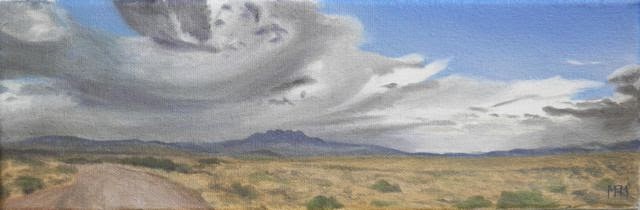
Two 4x12 inch landscape paintings on canvas. First one is of Four Peaks in Arizona, and the second is a view from Big Bend, in west Texas. 
Four Peaks, 4x12 in, oil on canvas, probably finished.
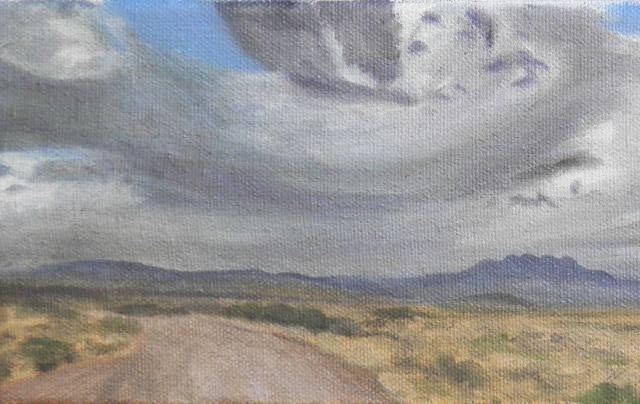
Four Peaks, detail. 
I changed the color of the blue in the sky on Four Peaks, the first color just didn't match. So the clouds aren't quite blended to the sky in a few places, but I don't think I'll spend any more time on this one.

Big Bend, 4x12 in, oil on canvas, finished. 
The sky is one of my favorites, it came out a subtle blue and blends into the haze of a hot afternoon. 

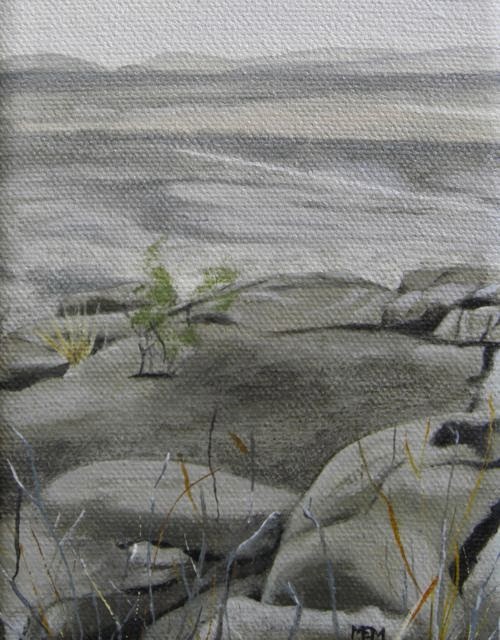
Big Bend, foreground detail.  
The paint on the rocks at the bottom is shiny from the Galkyd medium, to help it stand out from the far away background. The sky and the mid-ground was painted with no medium, so it's matte. I also found  a new trick for making really thin lines. The grasses were very tedious to do with a paintbrush, so I dipped a thread in paint, pulled it tight and stamped it down. Paint stayed exactly in a thin line, and some of it kept some raised texture. I think curved shapes could be made by carefully dropping the string from one end, too.